Amsterdam Time Machine
Navigate the City's History through Space and Time
A public research resource on the history of Amsterdam
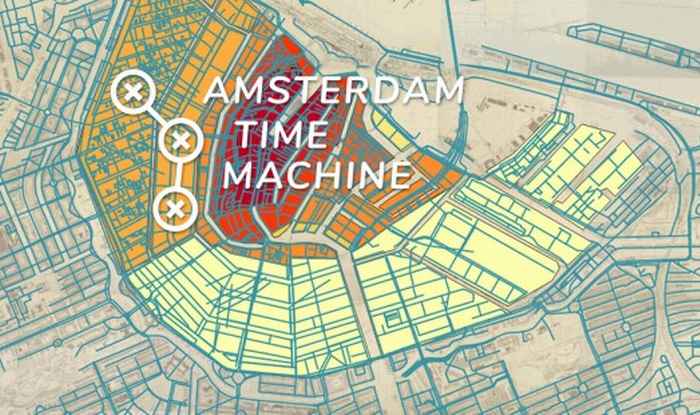
The Amsterdam Time Machine (ATM) is a research project led by Julia Noordegraaf at the Humanities Labs that provides new ways to access the history and memory of the city for purposes of enjoyment, education, research and urban development. Its front door is the ATM Data Index: an interactive, time-sensitive map of Amsterdam that presents the history and cultural heritage at the level of individual houses, streets and neighborhoods. The ATM connects a broad variety of information on places, people and events from archives, libraries, museums and community initiatives to the places and times they relate to and invites the development of new, inclusive perspectives on the history and memory of Amsterdam.
What makes it interesting for Shaping Interfaces?
Knowledge of the city’s past provides a useful, longitudinal perspective on current social issues, especially when this knowledge is democratically co-created with residents. For example, historical knowledge on residents’ everyday experiences and meanings regarding their neighborhood can lead to new insights into socially cohesive and sustainable urban development. By connecting digital heritage sources across collections and visualizing them on maps and timelines, the Amsterdam Time Machine is developing a user-friendly interface for dialogue on the experience and meaning of specific localities.
Together with the urban planning team of the municipality of Amsterdam, we are currently setting up a pilot study in which this interface is used by urban planners in the earliest exploratory phase of urban redevelopment. With this interface, planners have easy access to the documentation of the historical evolution of the neighborhood and its use and experience by residents – dimensions currently underutilized in the process of urban redevelopment. By embedding individual and collective memory within the planning toolkit, the approach strengthens and speeds up the analytical basis for decision-making in urban areas where complex transitions take place. This contributes to improved neighborhoods that support existing community structures and embed heritage while accommodating growth.
In the Inside-Out Time Machines project we collaborate with the Gouda, Hilversum and Utrecht Time Machine projects to further explore the democratization of cultural heritage. The project aims to develop approaches and tooling to enable residents to add their personal histories and historical knowledge to a Time Machine-interface. As such, we develop an accessible, bottom-up way of adding citizen perspectives on the cultural heritage of their own house, street, or neighborhood.
Partners
The Amsterdam Time Machine collaborates with Netherlands 3D, Oude Kerk Amsterdam, Bibliotheek UvA/Allard Pierson, Stadsarchief Amsterdam, SURF, Huygens KNAW, Netwerk Digitaal Erfgoed, The Dutch Time Machines and the Time Machine Organization Europe.
The Amsterdam Time Machine is also connected to the Amsterdam Humanities Hub, a collaboration between the Faculteit der Geesteswetenschappen of the UvA, the Institutes of the KNAW Humanities Cluster and the gemeente Amsterdam. This hub connects societal challenges with scientific knowledge, bringing together researchers and partners from the cultural sector, creative industries, government, and business.
The Team Behind the Amsterdam Time Machine
The Amsterdam Time Machine is coordinated by the CREATE research program at the University of Amsterdam and powered by a consortium of researchers and institutions. The project is run by a dedicated team of researchers and programmers, who work closely together with societal partners and local communities.
The Amsterdam Time Machine regularly organizes engaging events, such as data sprints where you can help build Amsterdam’s digital time machine. Have a question or an idea? Get in touch at amsterdamtimemachine@uva.nl.